How to build the primary shape
There is one shape that holds using only four sticks. I called them boomerangs when I was a wee little 7 yr old. This is a very easy shape to make, perfect for starting out. I highly advise finding a soft smooth surface you can push into, but sticks wont be able to get caught by. Such as as bed or lounge. This is so you can push sticks underneath oneanother.
This method below is the simplest way to make this shape, however there are various ways to make it (you'll get to do these later)
- Hold one stick in your left hand and another in your right hand
- Place down the left-hand stick first, then the right-hand stick on top of the first stick meeting near the ends of each stick.
- Place another stick on top of both sticks meeting at the opposite end of the left-hand stick, and the middle of the right-hand stick
- lightly hold in place the bottom left corner where two sticks meet with your left hand, and using your right hand, hold another stick from the top, pointing into the triangle created by the currently placed sticks.
- tuck the right-hand stick underneith the topleft corner stick, and over the middle stick
- place your index finger under the bottom tip of the right-most stick. Place your thumb on the bottom top of the middle stick you just put down, and twist the rightmost stick over the middle one
- slide and adjust the sticks to make the shape more tighter, and voila. you should be able to pick it up without it falling appart.
Materials
If you're new to this craft, you're probably looking at regular paddle-pop sticks/popsticks/popsicle sticks, which are small and quite limiting with what you can make.
I use wooden coffee stirring sticks, or long and thin craft sticks. Ideally, the longer and thinner, the better
A place to find these are your local dollar store or craft store, however they may not have the specific long and thing sticks you're looking for.
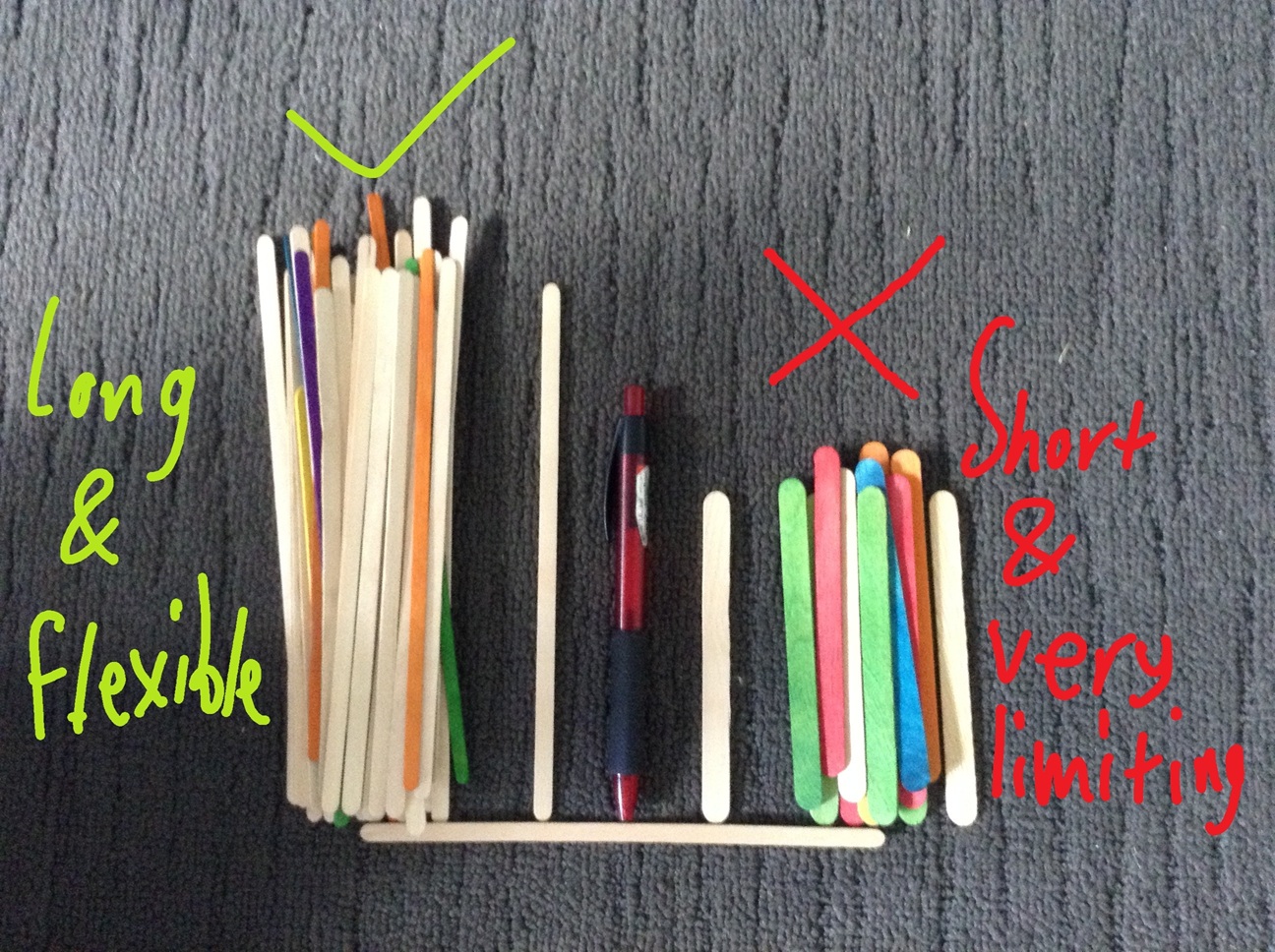
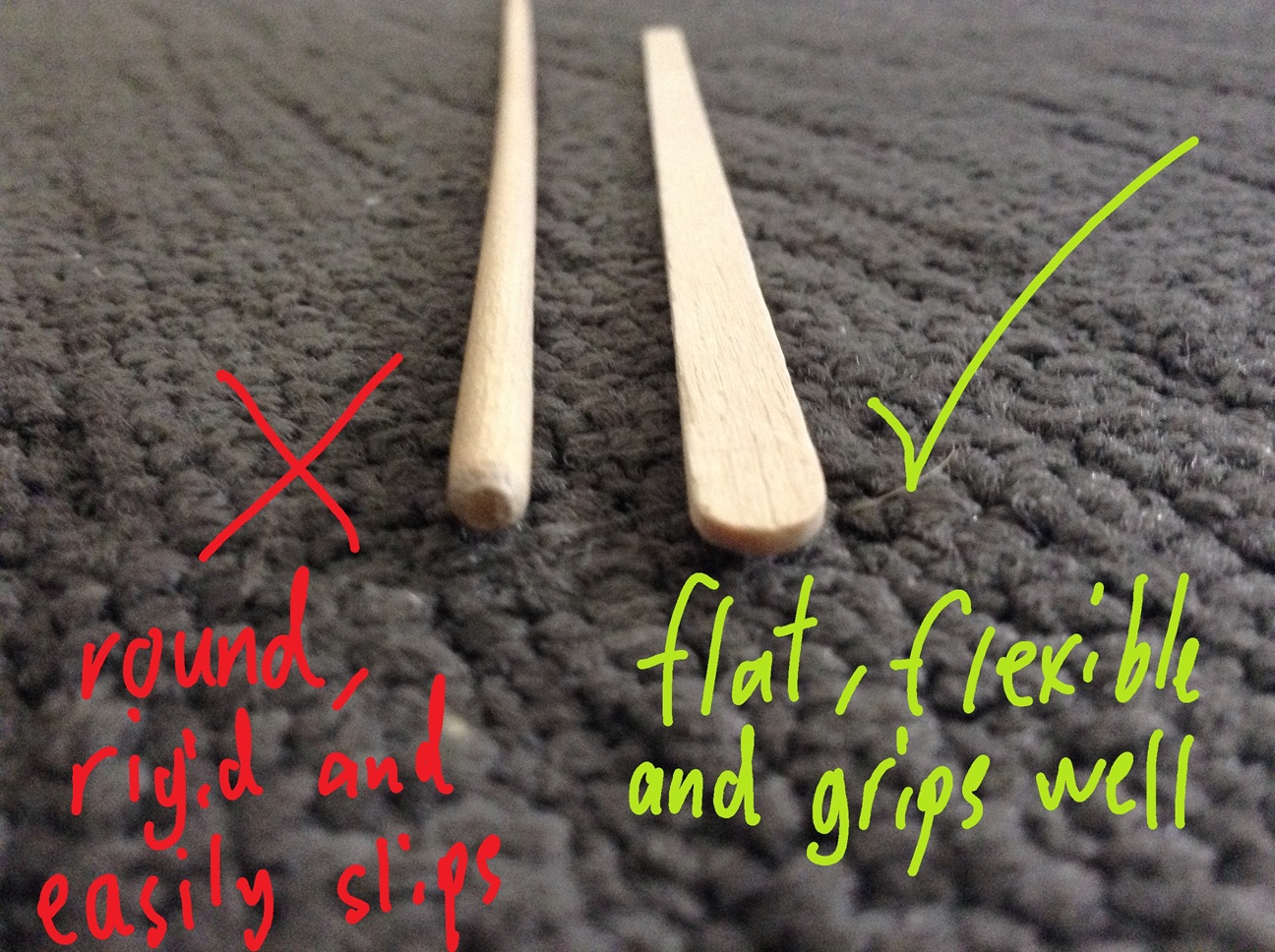
If you can find a more flexible but still elastic material than wood, you will have a much better time!
Tension
Perhaps the most important part of this craft is being able to understand how tension
To make a structure that holds together by itself, each stick needs to be in tension. A key principle is that all sticks must have at least 3 other sticks in contact in order to create tension. Why is this the case? Well its to make the stick bend. a stick cannot bend
Fragility
Structures held together entirely by tension and friction are of course fragile, and frequently slip and pop during construction. Here are some of the ways that sticks tend to missbehave, and some methods to reduce these troubles from occuring
Sandwiching
method of squashing sticks between other sticks to hold it in place without tension
Weaving methods
sometimes it's hard to get sticks to where you want them to be. SO i've found a number of methods to menuever sticks into position
Merging
In order to make larger complex structures, longer sticks feel all the more necessary. However there are methods to get around this limitation.
Merging is a method of essentially "lengthening" a stick by weaving a stick under and over the same sticks of another one. It can be used to attach shapes together.
Twist
An interesting behaviour of this craft is the phenomena of some shapes bending into the third dimention. This is a concept I call twist and can have interesting implications
3D
How do you make sticks pop into three-dee? that's a question i'm still trying to find an answer to, but I have found few techniques that work
yibber yabber here